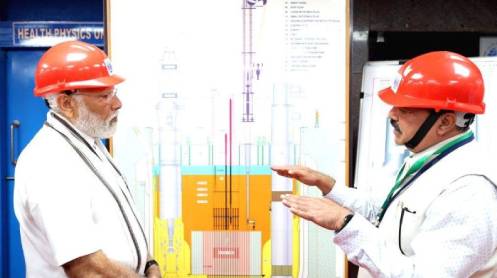
India has taken a significant step toward achieving nuclear fuel self-reliance as its indigenously developed Prototype Fast Breeder Reactor (PFBR) at Kalpakkam successfully reached “criticality”—a key stage where a self-sustaining nuclear chain reaction is established.
Prime Minister Narendra Modi described the milestone as a defining moment in the country’s civil nuclear journey, marking progress in the second phase of India’s long-term nuclear programme. He highlighted that the advanced reactor has the capability to produce more fuel than it consumes, underscoring the country’s growing scientific and engineering strength.
The development is particularly significant as it brings India closer to utilising its vast thorium reserves, which are seen as a crucial component of future clean energy strategies.
Although the reactor has achieved criticality, it is not yet supplying electricity to the national grid. Power generation will begin in subsequent phases once the reactor reaches full operational capacity.
India, currently the world’s most populous nation and third-largest emitter of greenhouse gases, aims to expand its nuclear power capacity dramatically—from around 8 gigawatts to 100 gigawatts by 2047. This push aligns with its broader commitment to achieving net-zero emissions by 2070.
The breakthrough also comes amid global energy uncertainties, including ongoing geopolitical tensions affecting fuel supply chains, further reinforcing the importance of energy security and diversification in India’s long-term strategy.
By AFP